Viewing Category » Training

Ultimate Quick Tips Reference Checklist

I’ve done a lot of reading of other blogs, books, and I’ve talked to a lot of people for many hours about ultimate. In all of that time, I’ve come up with a bit of a quick reference checklist that I think will help any level of player, captain and team before going into a practice, game, and especially a tournament.

Let me know what you think of my list of tips. What ones should I add?

  1. Shake the confidence of the other team by scoring on hucks

In Perfect Shape

 Practice,Psychology,Training 11 August 2010

How often do we head to a competition in perfect shape? Cardio is up, no injuries whatsover, well rested in terms of sleep and muscles, mentally fit as we can be, and no leftover twinge in that sprained ankle, pulled hamstring, or that torn ACL.

I wish I could say that I was in perfect shape for the upcoming Canadian Ultimate Championships in Sherbrooke but the reality is that I am not. At fitness practice last week I felt like my quads wouldn’t kick in during sprints, likely because my hamstring was pulled and my SI joint was locked because I hadn’t seen my chiropractor recently.

Expectations of Your Role On/Within a Team

Having clear expectations and setting reachable goals will help you enjoy playing ultimate better. Not only will it help define your role on the team but it will help you become a better player, it will help you enjoy practices and games more than you did before and it will help you be more effective when you practice.

Popularity: 52%

Cutting in Ultimate – The Finer Points

A cut is a simple movement on the field but it’s often done poorly since most people have never learned how to cut. This article contains tips that will help you become a better cutter, that will help you think smarter on the field, and that will improve your foot speed, improving your overall game.

First of all, why do players tend to cut poorly?

Throwing Outside Part 2 – March 25, 2010

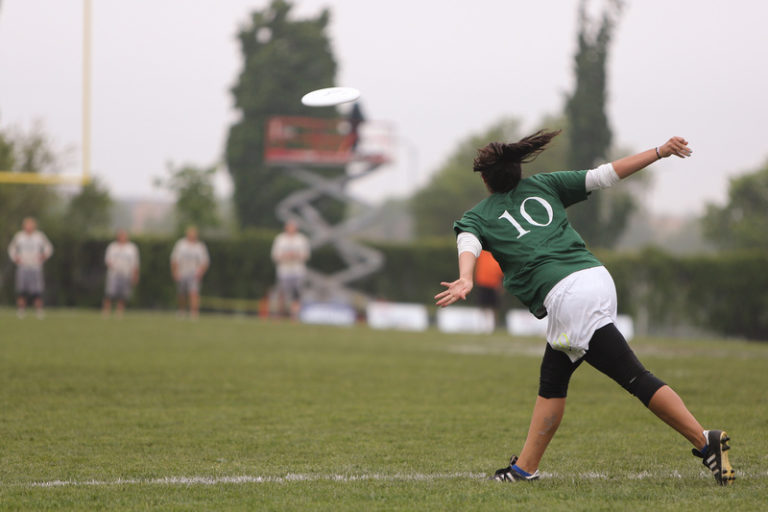
My buddy Tyler and I went throwing outside and I set up the video camera to capture our throws. Getting out and throwing with someone is a great way to work on your throws but make sure to focus on having good form and thinking about where you want your throws to go. Also, learn how the disc moves through the air and practice reading the disc so you’ll be a better receiver/defender in a game.

Popularity: 91%

Throwing Outside Part 1 – March 25, 2010

My buddy Tyler and I went throwing outside and I set up the video camera to capture our throws. Getting out and throwing with someone is a great way to work on your throws but make sure to focus on having good form and thinking about where you want your throws to go. Also, learn how the disc moves through the air and practice reading the disc so you’ll be a better receiver/defender in a game.

Popularity: 100%

Throwing Drill – Throwing into a Soccer Net

 Drills,Throwing,Training,Videos 24 March 2010

I explain what I mean by practicing throwing on your own as a way to develop your throw more effectively. This is one of my favourite drills for improving my mechanics, technique and the consistency of my throws.

Popularity: 47%

Some thoughts on offseason training

 Training 2 February 2010

I don’t claim to be a personal trainer by any stretch, but I have been playing sports my whole and have been successful at every sport I’ve played – a large part of which is due to my speed so I like to think I know what I’m talking about.

For ultimate, there are many elements which will contribute to your success and nothing will be a substitute for having good disc skills (throwing & catching) but the one skill that you can control absolutely is your fitness.

Teaching the Brain Motor Skills

 Practice,Psychology,Training 27 January 2010

Brain science tells us that the brain uses different processes and different parts for gaining different types of knowledge. The type of conscious, or explicit, knowledge we learn in school is controlled by the prefrontal cortex. The logical prefrontal cortex can quickly solve rational problems and learn step by step tasks. Using the prefrontal cortex, we can analyze what we know, we can show our work in math problems, or explain to someone else how we performed a task.

More Surprising Findings from the World of Biomechanical Analysis!

 Practice,Psychology,Throwing,Training 13 January 2010

This is part II of the summary I began last week (located here). Today’s discussion has important implications for how we instruct new players in learning to a forehand.

In case you’re just joining us, I’m reviewing an article published in Sports Biomechanics called “Biomechanical analysis of the sidearm throwing motion for distance of a flying disc: a comparison of skilled and unskilled players.” (Being a scientist, I should make it clear that my analysis of the work reported is very similar to, but not exactly the same as the conclusions arrived at by the authors of the paper. So this is not a direct summary of the paper.)

 1  2 »
Zionn designed by ZENVERSE  |  In conjunction with Reseller Hosting from the #1 Web Hosting Provider - HostNexus.